 W
WAfternoon Tea is a 1910 oil painting by American artist Richard E. Miller, located in the Indianapolis Museum of Art, which is in Indianapolis, Indiana. Like many of Miller's paintings, it depicts women in a sunny scene, filled with flowers, depicted in his Impressionist style with a distinct flavor of Japonism.
 W
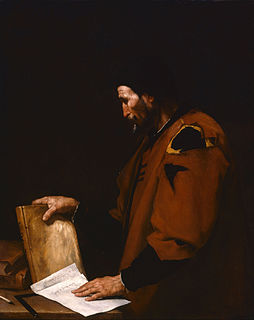
WAristotle is a 1637 oil painting by Spanish artist Jusepe de Ribera, located in the Indianapolis Museum of Art, which is in Indianapolis, Indiana. It is part of a series of six portraits of ancient philosophers commissioned by the Prince of Liechtenstein in 1636.
 W
WThe Banks of the Oise near Pontoise is an 1873 oil painting by French artist Camille Pissarro, located in the Indianapolis Museum of Art, which is in Indianapolis, Indiana. It depicts the river Oise near the market town of Pontoise.
 W
WBattle Between Carnival and Lent is an oil painting by Dutch artist Jan Miense Molenaer, located in the Indianapolis Museum of Art, which is in Indianapolis, Indiana. Painted roughly 1633–1634, it depicts a brawl between rowdy peasants, representing Carnival, and a group of monks, representing Lent. The rowdy combatants are armed with comical implements representing their sides, such as a peasant with a beer tankard battling a monk armed with fish.
 W
WBlasting St. Vincent's Rock, Clifton is a watercolor created by Norwich artist John Sell Cotman. Created in 1830, it is currently part of the permanent collection in the Indianapolis Museum of Art.
 W
WThe Boat Builders is an oil painting on panel by American landscape painter Winslow Homer, which is held in the collection of the Indianapolis Museum of Art (IMA), in Indianapolis, Indiana, United States.
 W
WThe Boy is an oil painting by Italian artist Amedeo Modigliani created in 1919. It is currently part of the permanent collection at the Indianapolis Museum of Art.
 W
WBreton Women at a Wall is an oil painting by Émile Bernard. It is part of the permanent collection of the Indianapolis Museum of Art.
 W
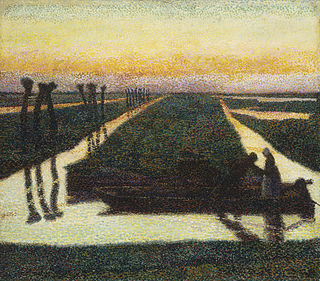
WBroek in Waterland is an 1889 oil painting by Dutch-Indonesian artist Jan Toorop, located in the Indianapolis Museum of Art in Indianapolis, Indiana. It is a pointillist image of the Dutch village of Broek in Waterland at twilight.
 W
WThe Channel of Gravelines, Petit Fort Philippe is a pointillist painting by French artist Georges Seurat, located in the Indianapolis Museum of Art in Indianapolis, Indiana. Painted in 1890, the year before his death, it depicts a harbor in the small French port of Gravelines. Described as "wistful and poetic," it is one of the treasures of the IMA.
 W
WCharing Cross Bridge is a series of oil paintings by French artist Claude Monet. The paintings depict a misty, impressionist Charing Cross Bridge in London, England. Monet worked on the series from 1899 to 1905, totaling 37 paintings of the bridge.
 W
WCliff Rock - Appledore is an oil painting by American artist Childe Hassam, painted in 1903. It is currently part of the permanent collection at the Indianapolis Museum of Art.
 W
WThe Country Dance is an oil painting by French artist Jean-Antoine Watteau, located in the Indianapolis Museum of Art, which is in Indianapolis, Indiana. Probably one of Watteau's earliest painting, created roughly 1706-1710, it depicts a group of quite courtly peasants dancing among the trees.
 W
WCourre Merlan is an oil painting by French artist Jean Dubuffet. It has been part of the permanent collection of the Indianapolis Museum of Art since 1992.
 W
WCrucifixion is an oil painting by German artist Lucas Cranach the Elder. One of many versions of the subject painted by Cranach, this one, created in 1532, is now in the Indianapolis Museum of Art.
 W
WCrucifixion is a 1375 panel painting by Italian artist Barnaba da Modena, located in the Indianapolis Museum of Art, which is in Indianapolis, Indiana. It depicts the crucifixion of Jesus in tempera and gold.
 W
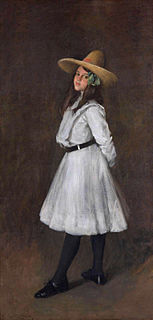
WDorothy is an oil painting by American artist William Merritt Chase. Created in 1902, it is currently part of the permanent collection in the Indianapolis Museum of Art.
 W
WEnclosed Field with Peasant is an oil painting by Dutch artist Vincent van Gogh, painted around 12 October 1889. The Size 30 painting, measuring 73 cm × 92 cm, depicts a scene of a ploughed field near the asylum at Saint-Rémy-de-Provence, with a lilac bush, a peasant carrying a wheatsheaf, several buildings, and the Alpilles mountains rising behind, with a small patch of sky. Van Gogh considered it a pendant painting to The Reaper executed earlier in 1889. It is currently part of the permanent collection at the Indianapolis Museum of Art.
 W
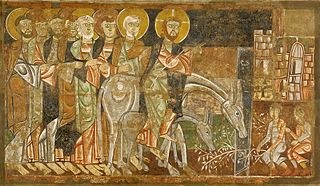
WEntry of Christ into Jerusalem is an 1125 fresco by the Master of San Baudelio de Berlanga, originally located at San Baudelio de Berlanga but now on display in the Indianapolis Museum of Art, which is in Indianapolis, Indiana. It depicts Christ and seven disciples entering Jerusalem to the acclaim of its inhabitants.
 W
WEntry of Christ into Jerusalem is a 1617 oil painting by Flemish artist Anthony van Dyck, located in the Indianapolis Museum of Art, which is in Indianapolis, Indiana. It depicts Jesus entering Jerusalem as described in the Gospels, the event celebrated on Palm Sunday.
 W
WThe Fifth Plague of Egypt is an oil painting by Romantic English artist Joseph Mallord William Turner currently in the permanent collection at the Indianapolis Museum of Art. Despite its title, it depicts Moses cursing the Egyptians with a plague of hail and fire, known as the seventh plague.
 W
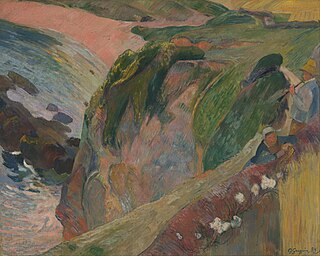
WThe Flageolet Player on the Cliff is an 1889 oil painting by French artist Paul Gauguin, located in the Indianapolis Museum of Art, which is in Indianapolis, Indiana. It depicts a Breton couple on a narrow path precipitously overlooking the Atlantic.
 W
WThe Flight into Egypt is a 1635 oil painting by French artist Claude Lorrain, located in the Indianapolis Museum of Art, which is in Indianapolis, Indiana. It depicts the Flight into Egypt, when the Holy Family fled to Egypt to escape Herod's persecution.
 W
WThe Holy Family with Saint John the Baptist is an oil painting by Italian artist Giovanni Francesco Bezzi, also known as Nosadella, located in the Indianapolis Museum of Art, which is in Indianapolis, Indiana. Painted roughly 1550-1560, it depicts Jesus, Mary, Joseph, and John in a powerful, Mannerist style.
 W
WHotel Lobby is a 1943 oil painting on canvas by American realist painter Edward Hopper; it is held in the collection of the Indianapolis Museum of Art (IMA), in Indianapolis, Indiana, United States.
 W
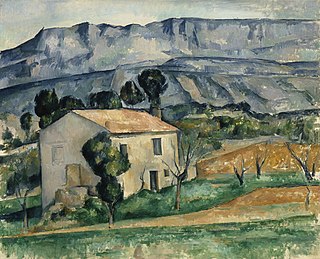
WHouse in Provence is an oil painting by French artist Paul Cézanne. Created between 1886 and 1890, it is currently part of the permanent collection in the Indianapolis Museum of Art.
 W
WThe House of the Deaf Woman and the Belfry at Eragny is an 1886 oil painting by French artist Camille Pissarro, located in the Indianapolis Museum of Art, which is in Indianapolis, Indiana. It is a view of Pissarro's neighbor's yard in Eragny, created during his brief period of experimentation with pointillism.
 W
WHurricane is a 1944 oil painting by American artist John Marin, located in the Indianapolis Museum of Art, which is in Indianapolis, Indiana. He used quick brushstrokes and thickly daubed paint to depict a turbulent ocean such as he experienced near his summer home in Maine.
 W
WJimson Weed is an oil on linen painting by American artist Georgia O'Keeffe from 1936, located in the Indianapolis Museum of Art in Indianapolis, Indiana. It depicts four large blossoms of jimson weed. A similar work by O'Keeffe, Jimson Weed/White Flower No. 1, was sold by the Georgia O'Keeffe Museum at auction to Walmart heiress Alice Walton in 2014 for $44,405,000, more than tripling the previous world auction record for a piece by a female artist.
 W
WLandscape near Arles is an 1888 oil painting by French artist Paul Gauguin, located in the Indianapolis Museum of Art, which is in Indianapolis, Indiana. It depicts a rural scene in Provence.
 W
WThe Love Song is an oil painting by American artist Norman Rockwell, located in the Indianapolis Museum of Art, which is in Indianapolis, Indiana, United States. It originally appeared in the Ladies Home Journal in December 1926. It depicts two elderly musicians, on flute and clarinet, playing a duet while a young girl takes a break from sweeping to listen. The painting's title appears on the sheet music from which the musicians play.
 W
WMa Jolie is an oil painting by Spanish artist Pablo Picasso, located in the Indianapolis Museum of Art, in Indianapolis, Indiana, USA. Completed in 1914, its fractured depiction of everyday objects is an example of cubism. It is not to be confused with the 1912 Picasso of the same name, now in the Museum of Modern Art in New York.
 W
WMadonna and Child with St. John the Baptist and St. Mary Magdalene is a painting by Neroccio di Bartolomeo de' Landi. The painting is a tempera on wood from 1495. It is currently held by the Indianapolis Museum of Art.
 W
WMorning at Grand Manan is an 1878 oil painting by Alfred Thompson Bricher. It is part of the permanent collection at the Indianapolis Museum of Art, and is currently on view in the Paine Early American Painting Gallery.
 W
WPeasant with a Wheelbarrow is an oil painting by French artist Jean-François Millet, located in the Indianapolis Museum of Art, which is in Indianapolis, Indiana. Begun in 1848 but not finished until Millet found a buyer in 1852, it depicts a peasant man pushing a wheelbarrow.
 W
WPortrait of a Man is a c.1515 male oil on canvas portrait by Titian, now in the Indianapolis Museum of Art.
 W
WPortrait of a Young Man is a tempera on panel painting by Paolo Uccello, executed c. 1431-1436, now in the Indianapolis Museum of Art.
 W
WPreparing for the Matinee is an oil painting by American artist Edmund C. Tarbell, created in 1907. It is currently part of the permanent collection at the Indianapolis Museum of Art.
 W
WThe Rainbow is an 1878 oil painting by American artist George Inness, located in the Indianapolis Museum of Art, which is in Indianapolis, Indiana. It depicts a rainbow arcing across the sky after a storm.
 W
WRebecca and Eliezer at the Well is an oil painting by Italian artist Carlo Maratta, located in the Indianapolis Museum of Art, which is in Indianapolis, Indiana. It shows the story of Abraham's servant Eliezer giving Rebecca jewels to seal her betrothal to Isaac, after she had demonstrated the kindness foreseen by Abraham in offering water to Eliezer's camels.
 W
WRed Kimono on the Roof is an oil painting by American artist John Sloan, located in the Indianapolis Museum of Art, which is in Indianapolis, Indiana, USA. Painted in 1912, its down-to-earth subject matter and execution make it an excellent example of the work of the Ashcan School, which was active in New York City in the early years of the twentieth century.
 W
WReflections is an oil on canvas painting by American artist Arthur Dove from 1935, now in the Indianapolis Museum of Art, in Indianapolis, Indiana, US.
 W
WRêve de printemps is a 1901 painting by William-Adolphe Bouguereau. The painting is an allegory of spring, it shows a young woman sitting in a forest surrounded by three small amores who crown her with a wreath of spring flowers as déesse du printemps.
 W
WRoman Capriccio: The Pantheon and Other Monuments is a 1735 oil painting by Italian artist Giovanni Paolo Panini, located in the Indianapolis Museum of Art, which is in Indianapolis, Indiana. It depicts an array of famous Roman monuments in a rural setting.
 W
WThe Seamstress is an 1893 oil painting by French artist Édouard Vuillard, located in the Indianapolis Museum of Art, which is in Indianapolis, Indiana. It is a small, intimate image of a woman sewing.
 W
WThis 1629 self-portrait by Dutch painter Rembrandt van Rijn is part of the Clowes Fund Collection of the Indianapolis Museum of Art in Indianapolis, Indiana. It is among the earliest of over 40 self-portraits by Rembrandt, which he produced over the course of four decades.
 W
WStill Life with a Chinese Porcelain Jar is a 1669 oil painting by Dutch artist Willem Kalf, located in the Indianapolis Museum of Art, which is in Indianapolis, Indiana. It is a sumptuous still life displaying the sort of costly wares that flowed through the Netherlands during its heyday as a trade center.
 W
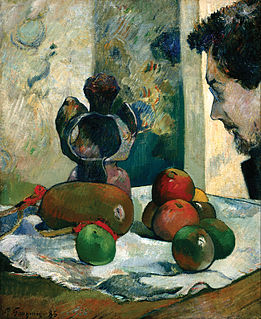
WStill Life with Profile of Laval is an 1886 oil painting by French artist Paul Gauguin, located in the Indianapolis Museum of Art, which is in Indianapolis, Indiana. It depicts Gauguin's friend Charles Laval in profile with an assortment of inanimate objects, including a ceramic pot Gauguin made himself.
 W
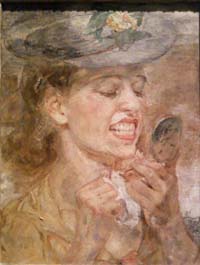
WSunlight is an oil painting by Frank Weston Benson currently in the permanent collection at the Indianapolis Museum of Art.
 W
WTidying Up is an oil painting by American artist Isabel Bishop. It is currently in the permanent collection at the Indianapolis Museum of Art.
 W
WTriptych of the Annunciation is a 1483 triptych by the Flemish artist known only as the Master of the Legend of Saint Ursula, located in the Indianapolis Museum of Art, which is in Indianapolis, Indiana. It depicts the Annunciation on the central panel, while the surrounding panels and the outside of the wings are covered in various pairs of male saints.
 W
WThe Two Sisters, also known as The Serruys Sisters is an 1894 oil painting by Belgian artist Georges Lemmen, located in the Indianapolis Museum of Art, which is in Indianapolis, Indiana. It uses pointillism to depict the sisters Jenny and Berthe Serruys.
 W
WU.S.A. is a trompe l'oeil oil painting by American artist John Haberle from 1889, located in the Indianapolis Museum of Art, which is in Indianapolis, Indiana. It depicts currency and stamps so realistically that Haberle was accused of pasting real money to the canvas.
 W
WUntitled is a 1938 tempera painting by American artist Jacob Lawrence, located in the Indianapolis Museum of Art, which is in Indianapolis, Indiana. Depicting a scene of childbirth in flat, geometric forms and bright colors, it is very much a product of the Harlem Renaissance.
 W
WThe Valkhof at Nijmegen is an oil painting by the Dutch Golden Age painter Aelbert Cuyp, likely painted between 1652 and 1654. It is now in the Indianapolis Museum of Art.
 W
WVorhor, the Green Wave is one of the most famous paintings by French artist Georges Lacombe. It is currently located in the Indianapolis Museum of Art, which is in Indianapolis, Indiana. Painted 1896-97, Lacombe used egg tempera and the inspiration of Japanese prints to depict the cliffs of Vorhor in Brittany.
W