 W
WPapyrus 5, designated by siglum 𝔓5, is an early copy of the New Testament in Greek. It is a papyrus manuscript of the Gospel of John dating palaeographically to the early 3rd century. The papyrus is housed in the British Library. It has survived in a very fragmentary condition.
WPapyrus 5, designated by siglum 𝔓5, is an early copy of the New Testament in Greek. It is a papyrus manuscript of the Gospel of John dating palaeographically to the early 3rd century. The papyrus is housed in the British Library. It has survived in a very fragmentary condition.
WPapyrus 5, designated by siglum 𝔓5, is an early copy of the New Testament in Greek. It is a papyrus manuscript of the Gospel of John dating palaeographically to the early 3rd century. The papyrus is housed in the British Library. It has survived in a very fragmentary condition.
 W
WPapyrus 10, signed by 10 and named Oxyrhynchus papyri 209, is an early copy of part of the New Testament content in Greek. It is a papyrus manuscript of the Epistle to the Romans, dating paleographically to the early 4th century.
WPapyrus 10, signed by 10 and named Oxyrhynchus papyri 209, is an early copy of part of the New Testament content in Greek. It is a papyrus manuscript of the Epistle to the Romans, dating paleographically to the early 4th century.
 W
WPapyrus Oxyrhynchus 211 is a fragment of the Perikeiromene (976–1008) of Menander, written in Greek. It was discovered in Oxyrhynchus. The manuscript was written on papyrus in the form of a roll. It is dated to the first or second century. Currently it is housed in the Houghton Library (3734) of Harvard University.
 W
WPapyrus Oxyrhynchus 213 consists of two fragments of a tragedy by an unknown author, written in Greek. It was discovered in Oxyrhynchus. The manuscript was written on papyrus in the form of a roll. It is dated to the second century. Currently it is housed in the British Library in London.
 W
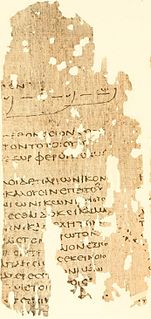
WPapyrus Oxyrhynchus 220 is a treatise on prosody, written by an unknown author in Greek. It was discovered in Oxyrhynchus. The manuscript was written on papyrus in the form of a roll. It is dated to the first century or second century AD. Currently it is housed in the British Library in London.
 W
WPapyrus Oxyrhynchus 221 contains Homeric scholia by an unknown author, written in Greek. It was discovered in Oxyrhynchus, Egypt. The manuscript was written on papyrus in the form of a roll. It is dated to the second century. Frederic G. Kenyon dated it to the first century or the first half of the second century. Currently it is housed in the British Library in London.
 W
WPapyrus Oxyrhynchus 222 is a list of ancient Olympic victors by an unknown author, written in Greek. It was discovered in Oxyrhynchus. The manuscript was written on papyrus in the form of a roll. It is dated to the third century. Currently it is housed in the British Library in London.
 W
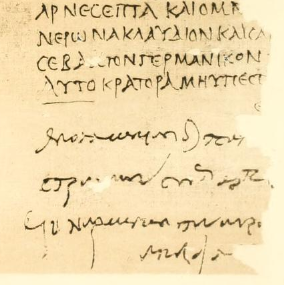
WPapyrus Oxyrhynchus 246 is a fragment of a registration of some sheep, written in Greek. It was discovered in Oxyrhynchus. The manuscript was written on papyrus in the form of a sheet. It is dated to 24 July 66. Currently it is housed in the Cambridge University Library in Cambridge.
 W
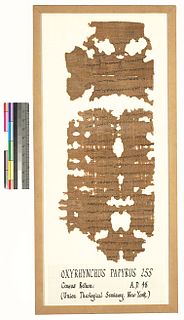
WPapyrus Oxyrhynchus 255 is a fragment of a census return, in Greek. It was discovered in Oxyrhynchus. The manuscript was written on papyrus in the form of a sheet. It is dated to the 28 September – 27 October 48. Currently it is housed in the Union Theological Seminary in New York City.
 W
WPapyrus Oxyrhynchus 282 is a fragment of a Complaint against a Wife, in Greek. It was discovered in Oxyrhynchus. The manuscript, written on papyrus in the form of a sheet, is dated between 26 January 29 – 22 May 37. It is housed in the Beinecke Rare Book and Manuscript Library of the Yale University in New Haven.