 W
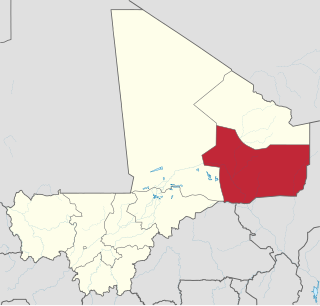
WThe Gao Region is a region in northeastern Mali. The capital city is Gao.
 W
WThe Third Battle of Gao was fought in the city of Gao on 9–11 February 2013, during the Northern Mali Conflict. It was a raid on the city by rebel MOJWA forces. The raiders were defeated by Malian government forces with the support of troops from France.
 W
WThe Ambush of Tagarangabotte took place during the Internal conflict in Azawad. A MUJAO column en route to Menaka fell into an ambush by the MNLA.
 W
WAnsongo Cercle is an administrative subdivision of the Gao Region of Mali. The administrative center (chef-lieu) is the town of Ansongo. The Niger River passes through the cercle and plays an important role in transportation and the economy in the region.
 W
WThe Battle of Gao was fought between the National Movement for the Liberation of Azawad (MNLA) and the Islamist Movement for Oneness and Jihad in West Africa (MOJWA), along with its ally Ansar Dine, in Gao between 26–28 June 2012. By the 28 June, Gao, Timbuktu and Kidal, the three biggest cities in the disputed secessionist region of Azawad within what is recognised as Malian territory, were under the control of Ansar Dine and its Islamist allies.
WThe Battle of Idelimane took place during the Internal Conflict in Azawad.
 W
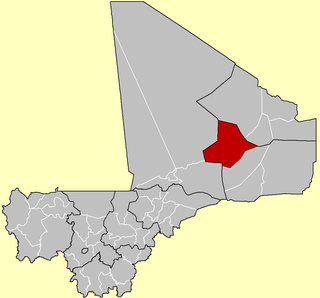
WBourem Cercle is an administrative subdivision of the Gao Region of north-eastern Mali. The administrative center (chef-lieu) is the town of Bourem.
WThe Fall of Timbuktu took place during the war in northern Mali. This is one of the first clashes between the MNLA and Ansar Dine.
WGao, or Gawgaw/Kawkaw, is a city in Mali and the capital of the Gao Region. The city is located on the River Niger, 320 km (200 mi) east-southeast of Timbuktu on the left bank at the junction with the Tilemsi valley.
 W
WGao Cercle is an administrative subdivision of the Gao Region of north-eastern Mali. The administrative center (chef-lieu) is the town of Gao.
 W
WGao-Saney is a medieval town close to Gao, the capital of the Gao Empire, situated on the eastern Niger Bend in the present-day Republic of Mali. Its ruins are four km distant from the royal town of Gao.
WThe Second Battle of Gao was the recapture of the city of Gao from Islamist MOJWA fighters by Malian/French forces. It took place in January 2013 within the Northern Mali Conflict.
WThe Fourth Battle of Gao was fought in the city of Gao on 20–22 February 2013, during the Northern Mali Conflict. It was an attempt by rebel MOJWA forces to retake the city. The attempt was repelled by Malian government forces with the support of troops from France and Niger.
 W
WOn March 23, a battle took place in Gao between MUJAO and Malian army. The Malian army repelled the attack.
WLa Dune Rose is an attraction in the city of Gao, Mali. The sand dune is named for its appearance at dawn and nightfall. It is also known as Koyma, the small town at its base.
 W
WA series of attacks took place in Mali in 2020. The attacks left at least 133 people dead and another 20 were injured.
WOn March 6, French and Malian forces took control of the Wadi Tin Keraten area, located 100 km east of Gao and northeast of Imenas. When Malian soldiers got near Tin Keraten, they were attacked by Islamists from MOJWA. French ground troops arrived supported by Tiger helicopters and Gazelles along with some warplanes. Four Malian soldiers were wounded during the battle and a French soldier, sergeant Wilfried Pingaud of the 68th Artillery Regiment in Africa, was mortally wounded. He was transported to Gao where he died of his wounds. The Islamists lost about ten men according to French reports.
 W
WThe Tomb of Askia, in Gao, Mali, is believed to be the burial place of Askia Mohammad I, one of the Songhai Empire's most prolific emperors. It was built at the end of the fifteenth century and is designated as a UNESCO World Heritage Site.