 W
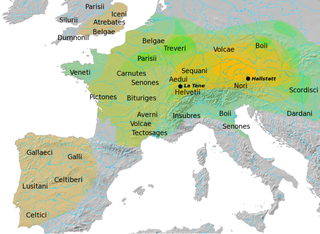
WThe La Tène culture was a European Iron Age culture. It developed and flourished during the late Iron Age, succeeding the early Iron Age Hallstatt culture without any definite cultural break, under considerable Mediterranean influence from the Greeks in pre-Roman Gaul, the Etruscans, and Golasecca culture, but whose artistic style nevertheless did not depend on those Mediterranean influences.
 W
WThe Agris Helmet is a ceremonial Celtic helmet from c. 350 BC that was found in a cave near Agris, Charente, France, in 1981. It is a masterpiece of Celtic art, and would probably have been used for display rather than worn in battle. The helmet consists of an iron cap completely covered with bands of bronze. The bronze is in turn covered with unusually pure gold leaf, with embedded coral decorations attached using silver rivets. One of the cheek guards was also found and has similar materials and designs. The helmet is mostly decorated in early Celtic patterns but there are later Celtic motifs and signs of Etruscan or Greek influence. The quality of the gold indicates that the helmet may well have been made locally in the Atlantic region.
 W
WAlcimoennis is the name widely attached to a Celtic Oppidum, or hill fort above the modern town of Kelheim in Bavaria, Germany. The name comes from Ptolemy, who in his Geography, only mentioned the name and described the location of the settlement. There is some controversy over the identification of the Kelheim remains with Alcimoennis, but it is still widely accepted.
 W
WThe Babilonie is a hillfort of the La Tène culture at a height of 255.6 metres above sea level on the northern edge of a rounded hill in the Wiehen Hills above the Lübbecke village of Obermehnen in the district of Minden-Lübbecke in the German state of North Rhine-Westphalia. The name is derived from the Germanic baben in the lon i.e. "up in the woods".
 W
WThe Bann disc is an Iron Age bronze artefact that was discovered in the River Bann near Coleraine, Northern Ireland, in 1939. It is a thin decorative piece emblazoned with a La Tène-style triskelion, with no obvious practical purpose. The emblem of the Coleraine Historical Society is based on the disc and its annual publication is called The Bann Disc Journal. It is currently on display in the Ulster Museum.
 W
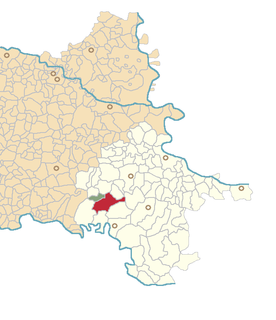
WCerna is a village and a municipality in eastern Croatia.
 W
WThe Dacian fortress of Mataraua was a Dacian fortified town, dating from the La Tène culture.
 W
WDalj is a village on the Danube in eastern Croatia, near the confluence of the Drava and Danube, on the border with Serbia. It is located on the D519 road, south of its intersection with the D213 road and the Vukovar–Erdut railway.
 W
WFestungsberg is a mountain in Salzburg municipality, Salzburg state, Austria. Its summit at about 542 m (1,778 ft) is the site of Hohensalzburg Fortress.
 W
WHollabrunn is a district capital town in the Austrian state of Lower Austria, on the Göllersbach river.
 W
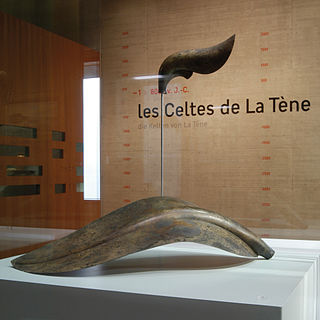
WLa Tène is a protohistoric archaeological site on the northern shore of Lake Neuchâtel, Switzerland. Dating to the second part of the European Iron Age it is the type site of the La Tène culture, which dates to about 450 BCE to the 1st century BCE and extends from Ireland to Anatolia and from Portugal to Czechia. La Tène is listed as a property of national significance.
 W
WLa Tène is a municipality in the Swiss canton of Neuchâtel. On 1 January 2009, the former municipalities of Marin-Epagnier and Thielle-Wavre merged to form the new municipality of La Tène.
 W
WThe Laténium is an archeology museum located in Hauterive, a suburb of Neuchâtel, Switzerland. Its name refers to the famous nearby site of La Tène which gave its name to the Second European Iron age. The Laténium is composed of a 2,500 m2 (27,000 sq ft) park and a museum building which also harbours the archaeological section of the Heritage Offices of the State of Neuchâtel, as well as the chair of prehistory of the University of Neuchâtel. The museum and its park are built on what used to be three archaeological sites that were excavated during the construction of the A5 motorway. Theses sites date from the Upper Paleolithic, Bronze Age and Neolithic. The park features dolmens and glacial erratics, reconstitutions of prehistoric and antique devices, and modern works of art. The museum displays the Bevaix boat, a 20 m (66 ft) Gallo-Roman ship found in Bevaix. Items from periods comprised between the Paleolithic to the Middle Ages are on display, including the remains of a Magdalenian hunting camp.
WMarin-Epagnier was a municipality in the district of Neuchâtel in the Swiss canton of Neuchâtel. On 1 January 2009, Marin-Epagnier and Thielle-Wavre merged to form the new municipality of La Tène.
 W
WMarkušica is a village and a municipality in Vukovar-Syrmia County in eastern Croatia. Markušica is located south of the river Vuka and northwest of the town of Vinkovci. Landscape of the Markušica Municipality is marked by the Pannonian Basin plains and agricultural fields of corn, wheat, common sunflower and sugar beet.
 W
WAn oppidum is a large fortified Iron Age settlement. Oppida are associated with the Celtic late La Tène culture, emerging during the 2nd and 1st centuries BC, spread across Europe, stretching from Britain and Iberia in the west to the edge of the Hungarian plain in the east. They continued to be used until the Romans conquered Southern and Western Europe. In regions north of the rivers Danube and Rhine, such as most of Germania, where the populations remained independent from Rome, oppida continued to be used into the 1st century AD.
 W
WThe Oppidum of Manching was a large Celtic proto-urban or city-like settlement at modern-day Manching, near Ingolstadt, in Bavaria, Germany. The settlement was founded in the 3rd century BC and existed until c. 50-30 BC. It reached its largest extent during the late La Tène period, when it had a size of 380 hectares. At that time, 5,000 to 10,000 people lived within its 7.2 km walls. Thus, the Manching oppidum was one of the largest settlements north of the Alps. The ancient name of the site is unknown, but it is assumed that it was the central site of the Celtic Vindelici tribe.
 W
WOppidum Uetliberg was a La Tène era oppidum located near the top of the hill Uetliberg in what is now the Swiss canton of Zurich.
 W
WOrolik is a village in Stari Jankovci municipality, Vukovar-Syrmia County, in eastern Croatia. The village is connected with the rest of the country by the D46 state road conecting it with the town of Vinkovci and continuing into Serbia as the State Road 120 to the nearest town of Šid, D57 road and by the M105 railway.
 W
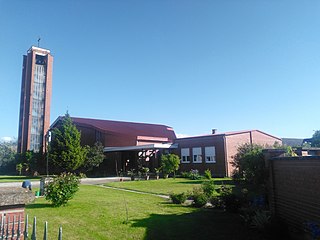
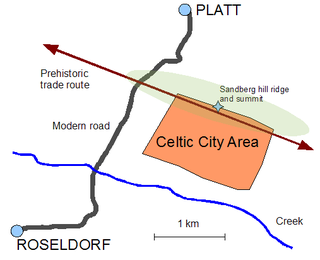
WPlatt is a village in the Zellerndorf administrative community in the district of Hollabrunn, Lower Austria, in northeast Austria. It is notable for its position on the Diendorf fault line and for its immediate vicinity to the site of one of the most significant Celtic settlements in Central Europe, situated on the southern slopes of the nearby Sandberg ridge towards the neighboring village of Roseldorf.
 W
WPrivlaka is a village in Croatia. It located in eastern Slavonia region, 12 km south of the town of Vinkovci. In the 2001 census, there were 3,776 inhabitants, of which 98.68% Croats.
 W
WThe Przeworsk culture was an Iron Age material culture in the region of what is now Poland, that dates from the 3rd century BC to the 5th century AD. It takes its name from the town Przeworsk, near the village where the first artifacts were identified.
 W
WThe Sandberg, a hill ridge in the northwestern part of the Weinviertel region of Lower Austria approximately 70 km north of Vienna, has recently emerged as one of the potentially most important archeological sites of the middle La Tène culture in Central Europe. The settlement which flourished there was not fortified, and therefore does not qualify as an oppidum. However, what is known to date suggests that it was not only large but also a wealthy and powerful center for trade, culture, religion and political power between southern Bohemia and the Danube valley. Its inhabitants are likely to have been Boii, or belonged to a Celtic tribe that was under their direct influence.
 W
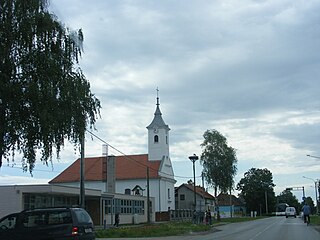
WSarvaš is a village in eastern Slavonia, Croatia, east of Osijek. It has a population of 1,539. It is administratively within the area of the city of Osijek. Szarvas means "deer" in Hungarian.
 W
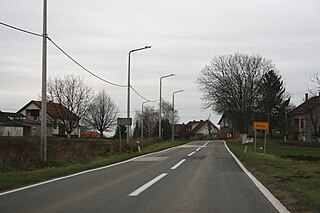
WSotin is a village in eastern Croatia, located a few kilometers southeast of Vukovar by the Danube. It is administratively part of the city of Vukovar, and its population is 782. The post code for Sotin is 32232 Sotin.
 W
WStari Mikanovci is a village in Croatia, located in the eastern part of the large Croatian historic and geographic region of Slavonia, situated in the westernmost part of the smaller Croatian historic and geographic region of Srijem.